 Lawrenceville Slab Leak Detectors
Sewer Slab Leak Detection in Lawrenceville, GA
What to do right now
- If water is pooling, flooring is lifting, or running water cannot be stopped, shut off your main water first if you can do so safely, then call us.
- Note the signs you see: bill jump, warm floor, running-water sound, low pressure, or damp flooring.
- Call (770) 520-8128 and tell us what you are seeing. Detection comes first, before any floor is opened.
Have this problem now? Call us.
A slab leak rarely fixes itself, and the longer water runs under concrete, the more it can wash out soil and lift flooring. One call gets you detection first — before anyone opens your floor. Call Lawrenceville Slab Leak Detectors at (770) 520-8128.
Call Us: (770) 520-8128What sewer slab leak detection fixes in your home
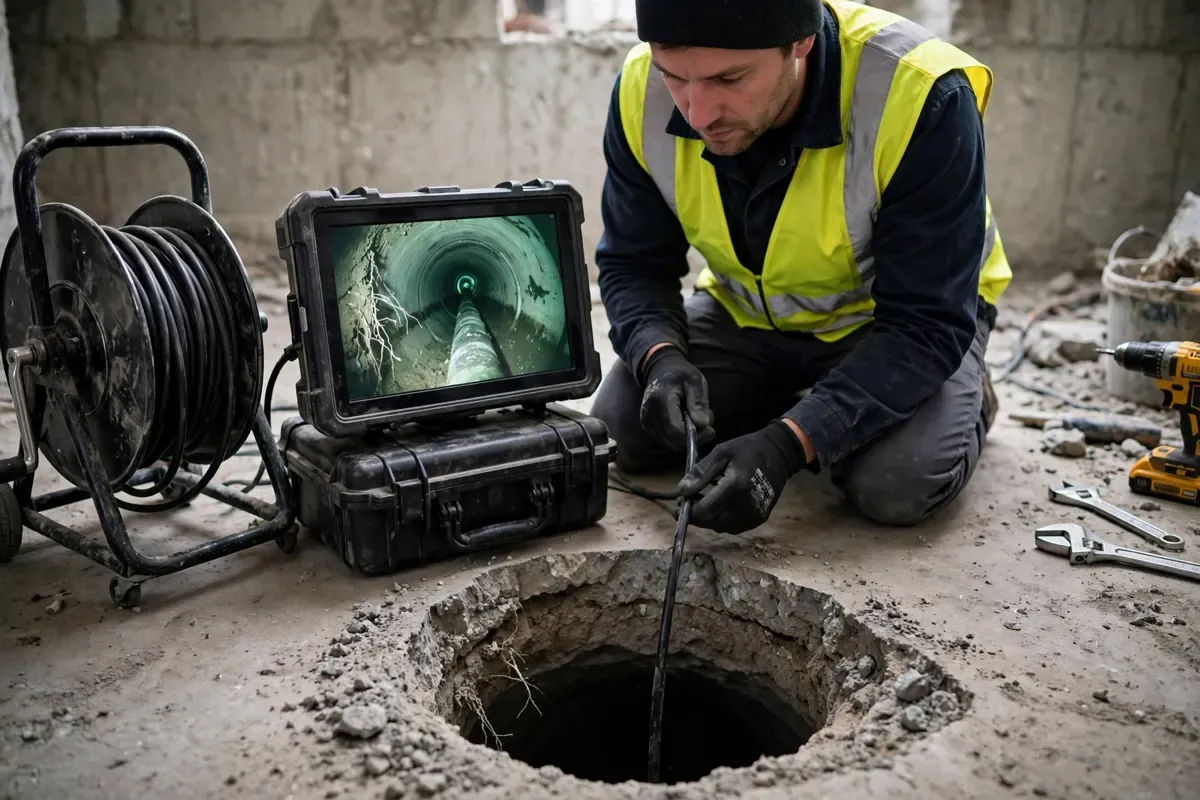
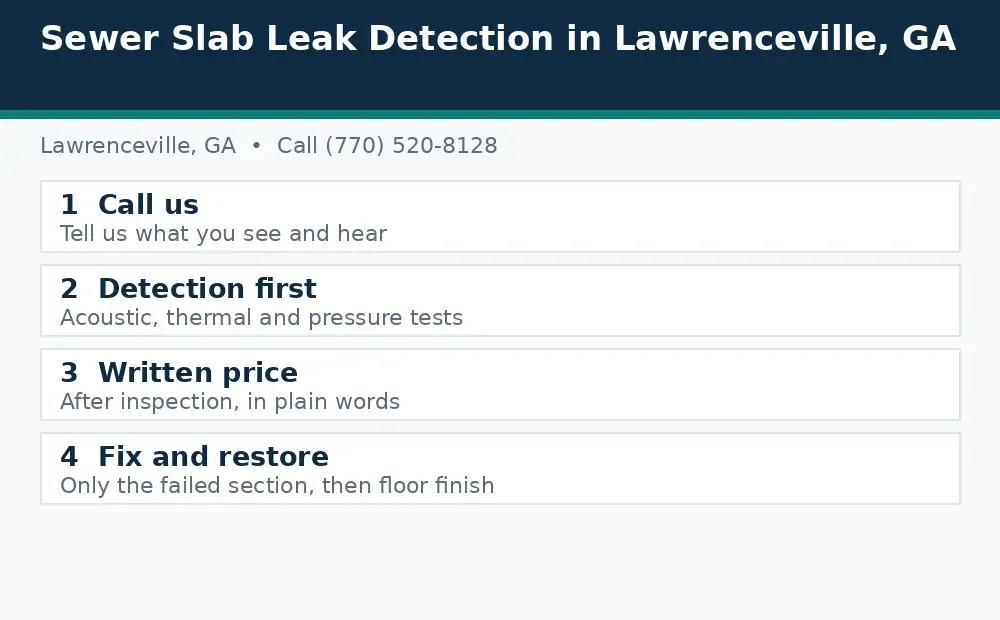
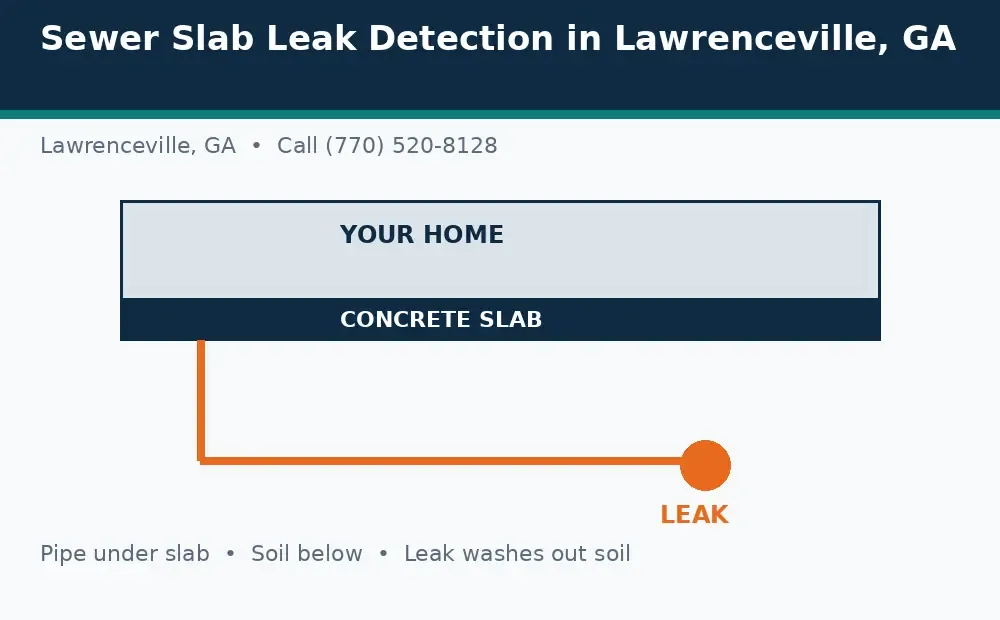
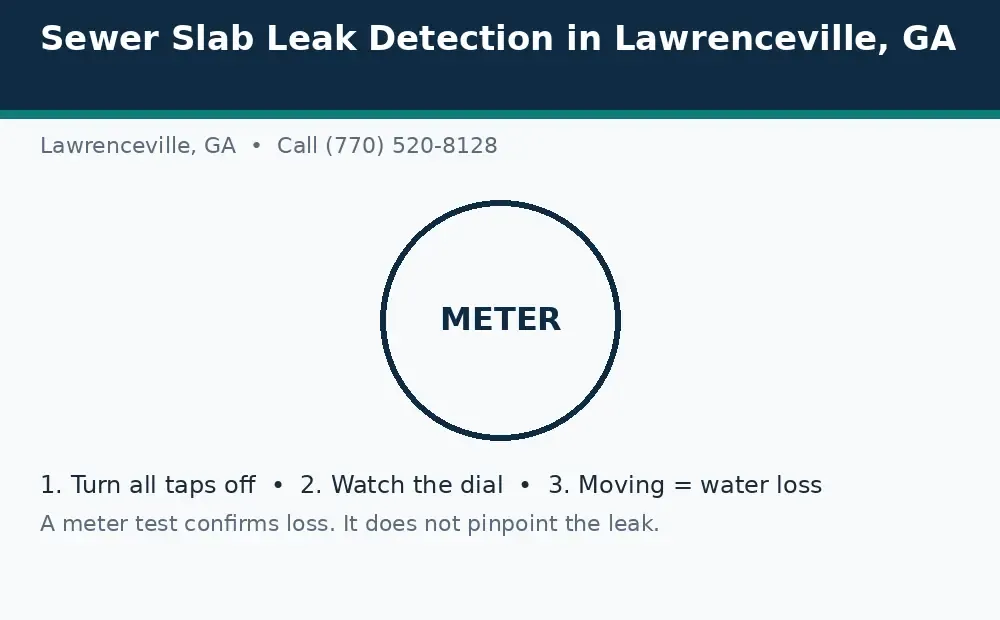
The working photo on this page is an illustrative working photo, not a photo of a specific job at a specific address. The diagrams are schematics, not to scale, made to explain the signs, process, options, or costs on this page in plain words. Call us at (770) 520-8128 if you are unsure what you are seeing.
Get sewer slab leak detection in Lawrenceville, GA
Call Lawrenceville Slab Leak Detectors at (770) 520-8128 for sewer slab leak detection in Lawrenceville, GA. We will find it, explain the fix in plain words, give you a written price after inspection, and fix it. Do not guess, and do not open your floor yourself.
A sewer leak under the slab is a drain-line break, not a pressurised supply leak, so your water meter may not rise. A sewer camera distinguishes a cracked lateral, root intrusion, or corroded cast iron from a supply leak. This is a service, not just information. When you call us, we find the exact problem, explain the fix that fits your home, and fix it. We do not guess, and we do not open more floor than needed.
Key points to know for this service are: supply vs sewer distinction, camera, smell, root intrusion, clay/cast iron lateral, why water bill may NOT rise for sewer. Those points are not filler. Each one changes the plan, the price, or the disruption, so a good visit covers them in order and explains them in plain words.
How we fix it for you
First, the problem is confirmed, not assumed. A meter or pressure check, a listen, or a camera check, depending on the service, tells us if the issue is really under the slab. Next, the exact location or the exact pipe run is pinpointed. Only then is a repair plan chosen.
You should get a clear plan in plain words: what will be done, what floor or wall work is needed, how long it usually takes, and what happens to flooring afterwards. If a plan cannot be explained in plain words, it is not ready to start.
- Confirm the problem first
- Pinpoint the location or pipe run
- Choose the repair that fits that leak
- Explain floor, wall, and flooring work before starting
Also see: slab leak repair.
Is this the right fix for your home?
The relationships that matter here are: Sewer Leak -> detected by -> Camera Inspection; Sewer Leak -> differs from -> Supply Leak (no meter rise); Sewer Leak -> caused by -> Cracked Lateral / Roots. Those relationships are the decision logic. They tell you when this service fits, and when a different service fits better.
For example, a single leak in healthy pipe is different from a repeat leak in an old system. A hot-water leak is different from a cold-water leak. A supply leak is different from a sewer leak. Naming that difference early saves time, money, and floor damage.
Also see: emergency slab leak repair.
Call Us Today
Talk to Lawrenceville Slab Leak Detectors about sewer slab leak detection in Lawrenceville, GA. No forms to wait on, just call and tell us what you are seeing.
Call Us: (770) 520-8128What it costs, and what you get
Costs on this site are market planning ranges, not quotes. The technician gives a written price after inspection, because access, depth, pipe material, and flooring change the price.
Planning ranges used across this site are: electronic detection around $300 to $600 in Georgia guides, spot repair roughly $500 to $4,000, a single-line reroute roughly $1,500 to $5,500, trenchless epoxy lining roughly $800 to $3,000 per line, and whole-home repipe roughly $4,500 to $15,000 or more. Flooring and concrete restoration can be separate. If a price sounds exact before anyone has seen your home, treat it with care.
Also see: areas we serve in Lawrenceville.
Why Lawrenceville homes book this service
Lawrenceville homes sit on red Georgia clay, which swells when wet and shrinks when dry and stresses pipe joints. Copper pipe in homes built from 1960 to 1990 often thins where it touches concrete. Near downtown, older galvanized pipe is common. In Collins Hill and Hurricane Shoals, gray polybutylene pipe from the 1980s and 1990s can split at fittings.
Lawrenceville Utilities runs the city's water, gas, and electric, so your meter and bill come from the city. A street-main issue is the city's job. Everything past the meter is a plumber's job. That split, plus the ZIP you live in, shapes what kind of leak is most likely in your home.
Also see: signs of a slab leak.
Ready to get it checked?
Talk to Lawrenceville Slab Leak Detectors about sewer slab leak detection in Lawrenceville, GA. No forms to wait on, just call and tell us what you are seeing.
Call Us: (770) 520-8128What happens when you call us
A visit starts with questions: what signs have you seen, when did they start, and has the bill changed? Then the technician checks the meter, pressure, and, where it fits, acoustic or thermal signs. You get a finding in plain words, not just a technical term.
After detection, you get options, not a single forced repair. Spot, reroute, lining, or repipe each fit a different pattern. The pro explains the trade-off for your home: cost, disruption, time, and how long the fix is expected to last.
Call us now to fix it
If you think you need sewer slab leak detection in Lawrenceville, GA, start with a call. Tell us the signs, the ZIP, and whether the floor is warm in one spot. That short call helps us tell you if detection is the next step, or if a simple check, like a running toilet, should be ruled out first.
Do not wait weeks if water is pooling, flooring is lifting, or running water cannot be stopped. Shut off your main water first, then call us.
Still unsure? Tell us what you are seeing
Talk to Lawrenceville Slab Leak Detectors about sewer slab leak detection in Lawrenceville, GA. No forms to wait on, just call and tell us what you are seeing.
Call Us: (770) 520-8128What to tell us when you call about sewer slab leak detection
You do not need to diagnose this yourself or know the fix name. When you call about sewer slab leak detection, tell us:
- The signs you see: bill jump, warm floor, running-water sound, low pressure, or damp flooring
- Whether water is pooling or flooring is lifting, so we know how urgent it is
- Your ZIP and street in Lawrenceville, so we can confirm your area
Detection comes first where it fits, before any floor is opened, and you get a written price after inspection.
How a visit works
- Call - tell us the signs, your ZIP and street, and whether water is pooling.
- Confirm - meter and pressure testing confirms water loss before anything is opened.
- Pinpoint - acoustic listening, thermal imaging and isolation testing narrow the leak before any concrete is touched.
- Written price - you get a written finding and a written price after inspection.
- Written finding - where the leak is, what kind of pipe it is, and which repair fits.
Which test finds your problem?
| Sign you see | Test that checks it | What it proves |
|---|---|---|
| Bill jump with no usage change | Water meter and pressure test | Confirms water loss |
| Running-water sound with taps off | Acoustic listening | Narrows the leak location |
| Warm floor spot | Thermal imaging | Points to a hot-water line area |
| Low pressure all over the house | Pressure and isolation testing | Confirms loss and isolates the section |
| Damp or warped flooring | Acoustic listening and thermal imaging | Pinpoints the area before any floor is opened |
More on detection methods
These pages cover the same topic, so you can compare options without guessing.
Frequently asked questions
Supply leak vs sewer leak under the slab — how to tell?
A sewer leak is a drain-line break, not a pressurised supply leak, so your water meter may not rise. A sewer camera can tell a cracked lateral, root intrusion, or corroded cast iron apart from a supply leak.
Does a sewer leak raise my water bill?
A sewer leak is a drain-line break, not a pressurised supply leak, so your water meter may not rise. A sewer camera can tell a cracked lateral, root intrusion, or corroded cast iron apart from a supply leak.
Does a sewer camera find it?
A sewer leak is a drain-line break, not a pressurised supply leak, so your water meter may not rise. A sewer camera can tell a cracked lateral, root intrusion, or corroded cast iron apart from a supply leak.
Does a sewer smell mean a sewer leak?
A sewer leak is a drain-line break, not a pressurised supply leak, so your water meter may not rise. A sewer camera can tell a cracked lateral, root intrusion, or corroded cast iron apart from a supply leak.
Can roots cause a slab sewer leak?
A sewer leak is a drain-line break, not a pressurised supply leak, so your water meter may not rise. A sewer camera can tell a cracked lateral, root intrusion, or corroded cast iron apart from a supply leak.
How do I book sewer slab leak detection in Lawrenceville, GA?
Call (770) 520-8128 and tell us the signs you are seeing. Detection comes first, before any floor is opened, and you get a written finding: where the leak is, what kind of pipe it is, and which repair fits.
Related slab leak services
Detection decides the repair. These are the services most often needed alongside this one.
Pinpoint a hidden leak before any floor is opened.
Listen for the leak instead of guessing where to cut.
Find warm-floor hot-water leaks with a thermal scan.
Spot repair, reroute, lining or repipe — whichever fits your home.
Water pooling or flooring lifting? Call first, then shut off the main if safe.
Concrete and flooring put back after detection and repair.
Related guides
What happens when you call about sewer slab leak detection
- Tell us the signs. Bill, sound, warm floor, pressure, damp patch, or water pooling — and whether you have done a meter test.
- Detection first. Pressure testing, acoustic listening and thermal imaging where they fit, to pinpoint the leak before any floor is opened.
- Written findings and a written price after inspection. Location, pipe type, and the fix that fits your home — not a price guessed from the phone call.
- Fix, then restore. Spot repair, reroute, lining or repipe as detection showed, then concrete and flooring put back.
If water is pooling, flooring is lifting, or running water cannot be stopped, shut off your main water if you can do so safely, then call (770) 520-8128.